
A person born in the US today, living the CDC’s current average of 79.0 years (Xu et al., 2026), will spend an estimated 126,000 hours on leisure screens: roughly 14 years of nonstop, 24-hour days. About 46,000 of those hours, around 5 years, go to social media.
These are my own estimates, built by stitching together surveys that measure different things in different ways, so treat them as good to about 20% either way. They are also not a verdict that every screen hour is wasted. Rest, connection and entertainment have real value. The useful question is the trade-off: one hour a day redirected from age 18 onward is about 22,000 hours, enough to build several serious skills. The rest of this article shows how the numbers were built, what research says about how long skills take (less than the popular “10,000-hour” idea for most goals, more for world-class performance), and why stopping is harder than it looks: many of these products are designed to hold attention.
How much time people spend
Leisure screen time rises through childhood, peaks in the teen years, and declines with age. In the chart, the grey bar is all non-work, non-school screen use and the blue bar is the part spent on social media.
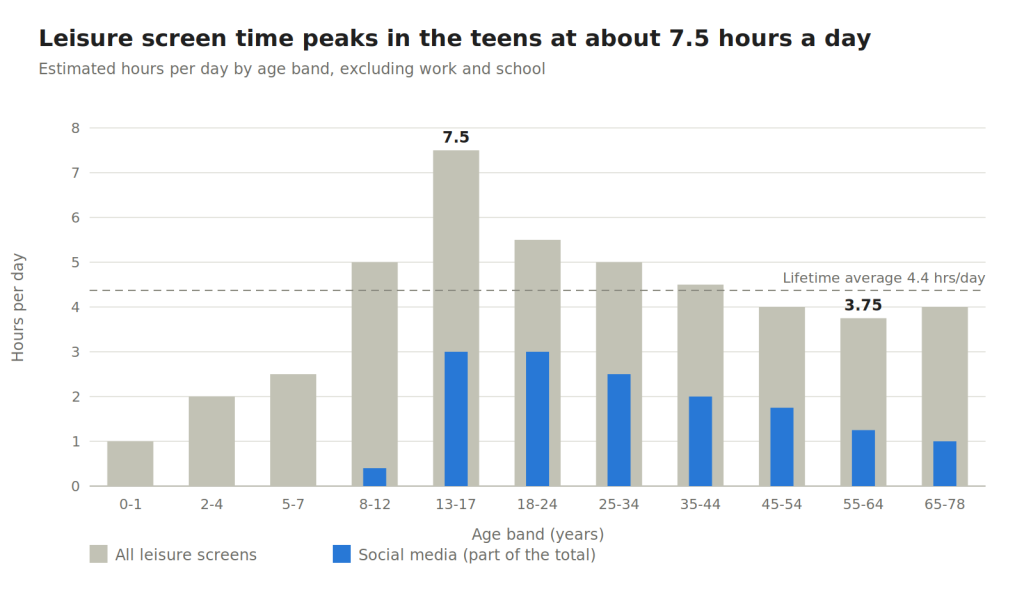
The anchors for the estimates are these. Common Sense Media’s census found US teens averaged 8 hours 39 minutes of entertainment screen media a day in 2021, up from 7 hours 22 minutes in 2019, with tweens at 5 hours 33 minutes and 4 hours 44 minutes (Common Sense Media, 2019; Gabb, 2026). I shaded the teen figure down to 7.5 hours because self-reports and multitasking inflate totals. For adults, estimates of total daily screen time run about 7 to 7.5 hours at ages 16 to 34 and about 5.3 hours at ages 55 to 64 (DemandSage, 2026), and I subtracted an assumed 1 to 2 hours of work screens for working-age adults. Older adults’ leisure screen time is mostly TV and video: about 4 hours 16 minutes a day for people 60 and over in federal time-use data analyzed by Pew Research Center (as cited in HabitDoom, 2026).
Social media averages about 2 hours 21 minutes a day worldwide, down slightly from a 2023 peak near 2 hours 31 minutes (SQ Magazine, 2026). Generational gaps are wide: about 3.2 hours for Gen Z against 1.5 for Baby Boomers in one GWI-based compilation (SociallyIn, 2026), while another source puts people 55 and over under 90 minutes (BroadbandSearch, 2025). Teen figures disagree most. Gallup’s 2023 survey found 4.8 hours a day (as cited in HabitDoom, 2026), while Common Sense Media reports about 1.5 hours (American Academy of Pediatrics, 2025). I used about 3 hours.
The lifetime math
Multiplying each age band’s daily hours by the years spent in it, then by 365, gives about 126,000 hours of leisure screen time over 79 years. That is a 4.4-hour daily average across a whole life, or roughly 27% of waking hours if you assume 16 waking hours a day. Social media alone comes to about 46,000 hours, a 1.6-hour daily average. A reasonable range for the total is 110,000 to 145,000 hours.
Teens use screens most intensely per day, but they are a small slice of a lifetime because the teen years are short. Adulthood and later life supply most of the hours.
Two cautions. Life expectancy at birth is a period measure built from current death rates, not a forecast for any individual (Xu et al., 2026), and a 25-year-old today will probably live past 79. The calculation also assumes each age keeps today’s habits. Today’s 65-year-olds grew up without smartphones. If today’s teens carry their habits into old age, lifetime hours could land above my range. If the recent plateau continues, with nearly a third of Gen Z reportedly deleting a social app in a year (SQ Magazine, 2026), they could land below it.
What those hours could buy instead
The fair framing is a trade-off, not a total. Nobody will, or should, turn every screen hour into practice. But a single hour a day from age 18 to 79 adds up to 22,265 hours, which is a lot of room.
The only widely cited hour counts I found for learning a skill come from the US Foreign Service Institute, which trains diplomats. It estimates about 600 to 750 class hours for an English speaker to reach professional working proficiency in languages such as Spanish and French, and about 2,200 for Arabic, Chinese, Japanese and Korean (Vivid Maps, 2026; LangMitra, 2026). Those figures come from intensive, full-time programs with teachers plus daily self-study, and the target is professional proficiency, not casual conversation (Vivid Maps, 2026). A self-directed learner at one hour a day should expect to be slower. Even so, at that pace a Romance language is roughly a two-year project and a hard language roughly a six-year one, and most of the budget is still left.
The 10,000-hour idea, and what it does and does not say
The 10,000-hour figure was popularized by Malcolm Gladwell (2008) from research by the psychologist Anders Ericsson. Ericsson later addressed the popular “rule”, noting that Gladwell presented it as a threshold for expertise (Ericsson & Harwell, 2019). Three points matter for anyone using it as a goal.
- It describes elite performance, not ordinary competence. The original comparison was among highly accomplished violinists, a narrow group (Macnamara & Maitra, 2019). Professional working proficiency in a language takes roughly 600 to 2,200 class hours, not 10,000, as the previous section showed.
- Quality counts alongside quantity. Ericsson’s term was deliberate practice, which he framed around concentration and analysis rather than mere duration (Ericsson & Harwell, 2019). Hours spent half-attending do not count the same way.
- Practice is not the whole story. A large meta-analysis found deliberate practice accounted for about 12% to 14% of differences in performance across music, games, sports, education and professions, and about 19% after correcting for measurement error, with large differences between fields (Macnamara et al., 2014; “The meta-analyses of deliberate practice,” 2021). Ericsson and Harwell (2019) reanalyzed a narrower set of studies and reported about 29% uncorrected, and up to 61% with their own corrections (“The meta-analyses of deliberate practice,” 2021).
The dispute is over how much practice explains, not whether it matters. Both sides agree it is important and not sufficient. The practical reading is to treat 10,000 hours as an upper-end marker for world-class performance in a competitive field, not as the price of “mastery.” Competence costs far less than most people assume, and for any given skill the hours are worth more when they are focused and come with feedback.
Designed to hold attention
Many of these products rely on features built to maximize engagement. The US Surgeon General’s 2023 advisory named push notifications, autoplay, infinite scroll and the like button among the design features that can encourage excessive use (Office of the U.S. Surgeon General, 2023).
The mechanism with the strongest theory behind it is variable reward. A slot machine pays out unpredictably, and researchers argue that the unpredictable rewards of social media, such as likes, new followers and the next item in an endless feed, engage the brain’s reward learning in a similar way, with infinite scroll and personalized recommendations adding new sources of unpredictability (Clark & Zack, 2023). A 2025 perspective article describes these as addictive algorithms and designs and argues they exploit psychological vulnerabilities to maximize engagement (Yao, 2025).
The direct evidence is thinner than the theory. Clark and Zack (2023) note that research on the effects of these specific features is limited, and cite one study in which scrolling was the only phone behavior that tracked with problematic smartphone use. They also note that social media use is not a formally recognized addiction diagnosis. Yao (2025), who argues for regulation, acknowledges limited direct causal evidence and recommends a precautionary approach.
The courts have started to weigh in. In March 2026 a Los Angeles jury found Meta and YouTube negligent in the design of their platforms in the first jury verdict in a social media addiction case, awarding the plaintiff $6 million in total, with Meta assigned 70% of the responsibility and YouTube 30% (NBC News, 2026; Sircar, 2026). The case focused on design rather than content, which avoided the legal shield for user-posted content (NPR, 2026). Meta and Google said they would appeal, and Meta noted that jurors were not unanimous (Fox News, 2026). In a separate New Mexico case that week, a jury ordered Meta to pay $375 million in civil penalties for failing to protect children from sexual exploitation (NBC News, 2026). According to the plaintiff’s lawyers, internal Meta documents shown at trial estimated more than four million Instagram users under 13 in 2015 (Business Wire, 2026).
A verdict settles a legal question for one plaintiff. It is not a scientific finding that social media is addictive, and the absence of a formal clinical diagnosis remains a complication for both law and science (Sircar, 2026). The evidence does support that these products are engineered to maximize time on the app, so willpower alone is competing against a design built to beat it.
Other costs: sleep, attention and mood
Time is only one cost. The best-supported mechanism for harm is sleep. A National Academies review concluded that the evidence linking social media to sleep loss is concerning and may be the most plausible route by which social media could harm young people, since scrolling displaces sleep and stimulates the brain at bedtime (National Academies of Sciences, Engineering, and Medicine [NASEM], 2024). The same review reports that social media use is thought to impair the ability to sustain attention, with some supporting evidence, including a UK analysis in which time on social media predicted concentration problems in adolescent girls (NASEM, 2024).
The mental health evidence is real but harder to read. In a study of 9- and 10-year-olds, more screen time was moderately associated with worse mental health, more behavior problems, lower academic performance and poorer sleep, but also with better-quality peer relationships (Paulich et al., 2021). A recent preprint, not yet peer reviewed, found a two-way relationship between screen time and adolescent mental health and a U-shaped pattern in which very low social media use was also linked to mental illness, which may mark socially isolated or already struggling teens (“The phenotypic and genetic relationship,” n.d.). The Surgeon General’s advisory likewise says social media has benefits for some young people and that the full extent of its impact is not yet known (Office of the U.S. Surgeon General, 2023).
In short, most of this evidence is correlational. Effects are small to moderate, they can run in both directions, and they vary by person and by how the platform is used. The sleep and attention findings are the ones most worth taking seriously, because they are plausible, affect everyone, and are the cheapest to act on.
What is not waste, and what the math leaves out
Calling 126,000 hours “wasted” overstates the case, for four reasons.
- Screens are not all one thing. Video calls with family, learning, music and creative work count in the same totals as mindless scrolling, and some social use is the main way people stay in touch. The Surgeon General’s advisory acknowledges benefits for some young people (Office of the U.S. Surgeon General, 2023).
- Rest is not waste. People need downtime, and many of the displaced hours would have gone to other leisure, not to practice.
- Time is not the only constraint. Skill practice takes energy and attention, which are often scarce after a workday, so a redirected hour is not guaranteed to be a productive one.
- The totals are estimates. They are built from self-reports and loosely matched age bands, and a 20% error either way would still leave the main conclusion standing.
The defensible claim is narrower than “screens waste your life.” By my estimate, leisure screens take about 27% of waking hours over a lifetime, and moving even a modest slice of that toward something a person cares about adds up to years of practice.
Practical takeaways
These are reasonable steps that follow from the evidence above. The sources I reviewed did not test them as interventions.
- Measure first. Your phone’s built-in screen time report shows your actual use, which avoids the error of self-reports.
- Pick one hour and one skill. A specific time slot and a skill with clear feedback, such as a language, an instrument or a craft, is more likely to stick than a general intention to do less.
- Add friction at the points in the loop. Turn off non-essential notifications, remove apps from the home screen, and avoid autoplay where the app allows it, since cues and missing stopping points are the features the research highlights.
- Protect sleep first. Sleep is the best-supported pathway to harm, so keeping screens out of the last hour before bed, which is associated with sleep disruption (Utah Department of Health and Human Services, n.d.), is the cheapest change with the strongest rationale.
- Set a realistic target. At one hour a day, a Romance language takes about two years and a hard language about six (see the chart above). Compare that with 27 years to reach 10,000 hours.
References
American Academy of Pediatrics. (2025). Average amount of screen time for children and young adults. https://www.aap.org/en/patient-care/media-and-children/center-of-excellence-on-social-media-and-youth-mental-health/qa-portal/qa-portal-library/qa-portal-library-questions/average-amounts-of-screen-time/
BroadbandSearch. (2025). Average time spent on social media per day in 2026. https://www.broadbandsearch.net/blog/average-daily-time-on-social-media
Business Wire. (2026, March 25). Jury hits Meta and YouTube with $3 million compensatory verdict in landmark social media addiction trial [Press release]. https://www.businesswire.com/news/home/20260325766197/en/
Clark, L., & Zack, M. (2023). Engineered highs: Reward variability and frequency as potential prerequisites of behavioural addiction. Addictive Behaviors, 140, Article 107626. https://doi.org/10.1016/j.addbeh.2023.107626
Common Sense Media. (2019). The Common Sense census: Media use by tweens and teens, 2019. https://www.commonsensemedia.org/sites/default/files/research/report/2019-census-8-to-18-key-findings-updated.pdf
DemandSage. (2026). Average screen time statistics (2026) – By age & country. https://www.demandsage.com/screen-time-statistics/
Ericsson, K. A., & Harwell, K. W. (2019). Deliberate practice and proposed limits on the effects of practice on the acquisition of expert performance: Why the original definition matters and recommendations for future research. Frontiers in Psychology, 10, Article 2396. https://doi.org/10.3389/fpsyg.2019.02396
Fox News. (2026, March 25). Los Angeles social media trial live updates. https://www.foxnews.com/live-news/los-angeles-social-media-trial-live-updates-03-25-2026
Gabb. (2026). Average screen time for teens: What parents should know. https://gabb.com/blog/average-screen-time-for-teens-what-parents-should-know/
Gladwell, M. (2008). Outliers: The story of success. Little, Brown and Company.
HabitDoom. (2026). Average screen time by age in 2026 (data and charts). https://habitdoom.com/blog/average-screen-time-by-age-2026
LangMitra. (2026). Easiest languages to learn for English speakers: The complete FSI ranking. https://langmitra.com/blog/easiest-languages-to-learn-fsi-ranking
Macnamara, B. N., Hambrick, D. Z., & Oswald, F. L. (2014). Deliberate practice and performance in music, games, sports, education, and professions: A meta-analysis. Psychological Science, 25(8), 1608–1618. https://doi.org/10.1177/0956797614535810
Macnamara, B. N., & Maitra, M. (2019). The role of deliberate practice in expert performance: Revisiting Ericsson, Krampe & Tesch-Römer (1993). Royal Society Open Science. https://hhs.purdue.edu/skill-learning-and-performance-lab/wp-content/uploads/sites/43/2024/08/macnamara-maitra-2019-the-role-of-deliberate-practice-in-expert-performance-revisiting-ericsson-krampe-tesch-romer.pdf
The meta-analyses of deliberate practice underestimate the effect size because they neglect the core characteristic of individualization—an analysis and empirical evidence. (2021). Current Psychology. https://link.springer.com/article/10.1007/s12144-021-02326-x
National Academies of Sciences, Engineering, and Medicine. (2024). The relation between social media and health. In Social media and adolescent health. National Academies Press. https://www.ncbi.nlm.nih.gov/books/NBK603429/
NBC News. (2026, March 25). Jury finds Meta and YouTube negligent in landmark lawsuit on social media safety. https://www.nbcnews.com/tech/tech-news/verdict-reached-landmark-social-media-addiction-trial-rcna263421
NPR. (2026, March 25). Jury finds Meta and Google negligent in social media harms trial. https://www.npr.org/2026/03/25/nx-s1-5746125/meta-youtube-social-media-trial-verdict
Office of the U.S. Surgeon General. (2023). Social media and youth mental health: The U.S. Surgeon General’s advisory. U.S. Department of Health and Human Services. https://www.hhs.gov/sites/default/files/sg-youth-mental-health-social-media-advisory.pdf
Paulich, K. N., Ross, J. M., Lessem, J. M., & Hewitt, J. K. (2021). Screen time and early adolescent mental health, academic, and social outcomes in 9- and 10-year old children: Utilizing the Adolescent Brain Cognitive Development (ABCD) Study. PLOS ONE, 16(9), Article e0256591. https://www.ncbi.nlm.nih.gov/pmc/articles/PMC8425530/
The phenotypic and genetic relationship between adolescent mental health and time spent on social media, gaming, and TV. (n.d.). medRxiv [Preprint]. https://www.medrxiv.org/content/10.1101/2023.09.14.23295537.full.pdf
Sircar, A. (2026, March 30). A $6 million jury verdict ruled social media is addictive. Now what? Forbes. https://www.forbes.com/sites/anishasircar/2026/03/30/a-6-million-jury-verdict-ruled-social-media-is-addictive-now-what/
SociallyIn. (2026, January 30). Social media use by generation 2026: Key statistics and trends. https://sociallyin.com/social-media-use-by-generation/
SQ Magazine. (2026). Social media statistics 2026. https://sqmagazine.co.uk/social-media-statistics/
Utah Department of Health and Human Services. (n.d.). How does social media affect sleep? https://socialharms.utah.gov/english/how-does-social-media-affect-sleep/
Vivid Maps. (2026). Language difficulty rankings. https://vividmaps.com/language-difficulty-rankings/
Xu, J., Murphy, S. L., Kochanek, K. D., & Arias, E. (2026). Mortality in the United States, 2024 (NCHS Data Brief No. 548). National Center for Health Statistics. https://dx.doi.org/10.15620/cdc/174641
Yao, Y. (2025). Regulating addictive algorithms and designs: Protecting older adults from digital exploitation beyond a youth-centric approach. Frontiers in Psychology, 16, Article 1579604. https://doi.org/10.3389/fpsyg.2025.1579604